
Transformational Trekking
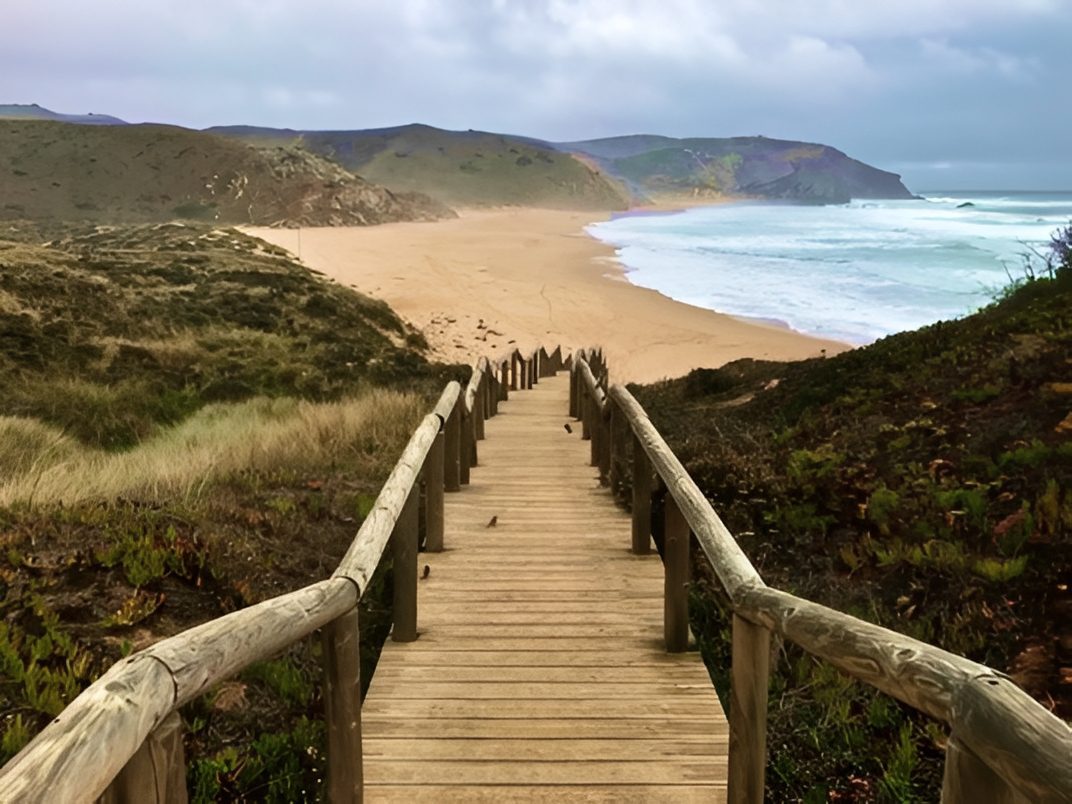
Best of Portugal’s Fisherman’s Trail & A Taste of the Historical Way Group Trek
TRIP PREPARATION PACKET
WELCOME! I am honored that you have chosen to join Transformational Trekking’s group trek along the Best of the Fisherman’s Trail & A Taste of the Historical Way of Portugal!
Trekking in Portugal is physically demanding, but I know that when travelers are prepared – physically (good conditioning), materially (proper gear) and emotionally (being open minded) – they have an overwhelmingly positive experience. I’ve tried to anticipate all your questions, but if I have missed anything please do let me know.
I wish you safe and happy trails along the wild Atlantic coast of Portugal. Until we meet, keep on trekking!
-Sheri Goodwin of Transformational Trekking
Advance Planning – What to Do in the Months Before Your Trip
Passport
You will need a passport that is current and valid for at least 6 months after your return. You should have a blank page for each country you will visit. If you do not have a passport, or need to renew your passport, and you are a U.S. citizen, here is information to help you: Visit the U.S. Department of State website: http://travel.state.gov/passport/ Don’t Delay!
Make two copies of your passport. Leave one copy with friends or relatives at home and keep the other one in a safe place in your backpack separate from your passport. This will help you replace your passport if it is lost.
ETIAS
Scheduled to start in the last quarter of 2026 (specific date still to be determined), the ETIAS will be required for US & Canadian citizens to enter many European countries. The ETIAS stands for EU Travel Information & Authorization System.
ETIAS Basics for American Citizens:
The ETIAS is only good for short-term stays of 90 days or less; it is not a work visa. The ETIAS information is linked to your passport, so if you have to replace your passport for any reason, you’ll also need a new ETIAS travel authorization. (Your travel insurance company should be able to assist with a lost passport.)
People Who Need ETIAS Authorizations
You will need to get a visa if any of the following apply to you:
- You’re not a European Union
- You’re citizen of any country, including the S., whose nationals don’t currently need a visa for a short-term stay in a European Union country.
- You don’t have a residence permit or card issued by any of the European countries that require ETIAS
- Some travelers may be exempted from the requirement for an ETIAS travel authorization, so check before you apply.
How to Apply for ETIAS
American citizens traveling to Europe can apply on the ETIAS website’s application section once it becomes operational (https://etias.com/etias-application). For notifications in the meantime, you can sign up for emails at the website. As of May 2026, the ETIAS application fee is €20. It’s free for anyone over the age of 70 or under 18.
How Long is the ETIAS Good For?
The ETIAS authorization is good for three years. You can only travel in a participating country for 90 days within any 180-day period. Whenever you travel to participating countries, your ETIAS authorization must be valid for the duration of the stay.
If your connecting flight to Portugal lands in Great Britain (England, Scotland, Wales & Northern Ireland) or you plan to travel in Great Britain before or after Portugal, you will also need an ETA.
ETA (Electronic Travel Authorization)
Great Britain now requires an ETA, for Canadian and US citizen entry. Any travel to Great Britain which includes England, Scotland, Wales and Northern Ireland will require you to have an ETA. The link below will help you get your ETA. As of May 7, 2026 they cost £20.
https://www.gov.uk/guidance/apply-for-an-electronic-travel-authorisation-eta For more information on how to get your ETA click here.
EES: (Entry/Exit System - Schengen Countries)
The rollout for this program started late in 2025. US and Canadian citizens will be asked to register and give specific information at a designated kiosk/computer upon reaching the border control of a Schengen country. When completed you won’t have to do it again for at least 3 years and your entry process into Schengen countries will be quick. The Entry/Exit System (EES) is an automated IT system that registers travelers' names, travel documents, biometric data, and entry/exit dates and locations to improve security, prevent illegal immigration, and ensure visitors don't overstay their authorized 90-day limit within the borders of the Schengen Area. This biometric information of travelers from non- Schengen countries is stored for three years. The use of the fully automated Entry/Exit System will save the time of manual passport stamping and simplify the border control process.
Travel Insurance
Due to this trip being an active trekking adventure, medical emergency/evacuation insurance is required. Your travel insurance must have minimum coverage limits of $100,000.00 USD for personal injury and medical treatment (medical emergency) and $200,000.00 USD for repatriation and evacuation expenses including international helicopter rescue and air ambulance services. If you have a pre-existing condition that you want insured while on your trek, then you will need to purchase your insurance within 7-21 days (depending on what insurance company you go with) of paying the deposit for this trip. Also be sure to ask if pre-existing conditions are covered for the above type of insurance. Some insurance companies will require you to purchase further trip coverage to cover pre-existing conditions.
Trip Cancellation/Interruption Insurance:
It is highly recommended to purchase this insurance in case you need to cancel part or all of your trip, or baggage is lost, etc. This would be the only way to be reimbursed for trip costs.
Insurance Companies:
There are many insurance companies you can go with: Travelex, Allianz, and Travel Guard are just a few. Shop around for the best coverage and price. Do your research to understand what is covered and what isn’t. Square Mouth (squaremouth.com) is a company that reviews travel insurance companies.
Through Square Mouth, you can get a quote and compare travel insurance policies from all major providers to find the best coverage for your trip for the lowest possible price. Also check your current health insurance/homeowners/credit cards to see if they have some coverage for you while abroad as well. If you would like personal help choosing your trip insurance, Pam Perry, a friend of Sheri’s, is an agent for Travelex Insurance and Square Mouth. She would be happy to answer questions and help you choose the best insurance plan for you. Her cell number: 206-617-0102 (best to text her) and her email: pamsbigadventure@gmail.com.
Once you book your insurance, be sure to let us know:
- Thename of your insurance company
- The24-hour emergency # and
- Yourpolicy #
During your trip, if you require emergency medical help or evacuation (e.g., helicopter evacuation), keep all paperwork and receipts from doctor’s appointments, extra transportation, and extra accommodations. Once home, the amount, with your documents and receipt, can then be submitted to your travel insurance company for reimbursement. Transformational Trekking will provide any other necessary documentation to your insurance company for the reimbursement. If you leave the trip early for any reason, Transformational Trekking will not pay for any costs incurred nor are you entitled to a refund.
Purchasing Flights
Only purchase your flight once the trip leader has given the go ahead. For this trek, it is best to fly into Lisbon International Airport. Be sure you arrive at least a day before the start date of the group trip, as this trip starts at 10:30AM, and most flights coming from the states would not get you to Lisbon in time for the group pick-up. Double-check the date and time you arrive, before purchasing your flight. We recommend, if you can, to arrive a few days early to explore beautiful Lisbon and to be well on your way to being acclimated to the time difference, by the time we meet as a group.
Medical Checkup
Transformational Trekking suggests that you have a medical checkup before your trip. Let your doctor know about any medical condition you have and discuss the details of the trip itinerary as it pertains to your health (i.e., 9-10 days of hiking, 2.5-11.5 miles each day). If you have a pre-existing medical condition or are over the age of 65, clearance (Signed Physician Questionnaire) from your physician is required for participation on this trip. This form will be sent to you after you have filled out the initial online form if you need it. Read number seven of the Terms and Conditions Form - “Health Requirements” - for more details.
Immunizations/Vaccines & Contagious Illness Requirements
There are no required immunizations for travel to and from Portugal. Some are recommended including Covid-19, Polio, Shingles, Flu, Chickenpox, Tetanus, Typhoid, MMR (basically your routine vaccinations), and Hepatitis A & B, as well as rabies. Seek independent medical advice from your physician or your county or city’s health service for the latest recommendations for immunizations. Many county governments offer immunization clinics where you can obtain shots at a reasonable cost. For up-to-date immunization information, contact the Center for Disease Control: 800-232-4636, or visit their website: http://www.cdc.gov.
*Tick-born encephalitis (TBE): TBE is not considered endemic in Portugal and cases are rare or non- existent compared to Central/Eastern Europe. There is a 3-part vaccine in the US (Ticovac) to help prevent TBE. The first two vaccines are taken about 14 days to 3 months apart and then the 3rd vaccine about 5-12 months after the 2nd vaccine. Talk with your doctor about your European travel plans before getting this vaccine to see if it is necessary for you.
Portugal’s Current (May 2026) Covid-19 requirements:
All requirements have been removed, except masks may still be required in hospitals.
TT’s Staying Healthy for Our Trek Requirements
Due to this being an energy intensive active adventure where we hike for 4-7 hours each day, preventing any contagious illness (not just Covid), is important. You will be asked to wear a mask at the airport, on the plane, and in other crowded public transport on your way to meet the group.
While on our group adventure: You may be asked to take a Covid test the morning of the day we meet as a group for the first time. And the group may be asked to wear a mask while in transfer vehicles up to the first 5 days of the trip.
If you experience any Covid/cold/flu symptoms (per CDC guidelines) you will be asked to take a Covid test and wear a mask. Disclose to your trip leader any Covid/cold/flu symptoms that you may have whether just prior to the first day of the trip or that develop during the group adventure.
If one participant tests positive in our group:
- Allmembers of the group need to be mindful of any symptoms that may arise, and if symptoms develop, they will need to wear a mask and test.
- Wearinga KN95 or N95 mask when indoors around each other for 5 days may be
You will need to bring the following with you on the group trip:
- Atleast 1 KN95 or N95 mask for each day of the
- 3Antigen Rapid Home Covid tests
- Athermometer
If one or more trekkers become unwell with a contagious illness
Trekkers exhibiting symptoms of the cold/flu/Covid will be asked to wear their N95/KN95 masks to help prevent further spread. Group interactions may be restricted during the contagious period or wearing a mask when around the group may suffice. TT will work with any illness that may arise on a case-by-case basis. Every situation is different and will need different decisions/solutions. The hope will be that TT can find a single room for the sick person where we are staying, but this is not always possible, as places we stay at are usually fully booked. We will take appropriate hygienic precautions as dictated by the illness. The person exhibiting symptoms may need to take one or more rest days to recover or may be okay to hike. If the illness is severe (such as a bad case of Covid or the flu), the sick person may need to leave the group and head to a bigger community where there are medical services and plenty of food options. When traveling in vehicles together when one or more trekkers are sick, we will take appropriate hygienic precautions (for example wearing a mask, using hand sanitizer, opening windows, etc.). Any extra expenses (single room, food, medical, transportation) due to being sick is the responsibility of the person who is sick. Please know TT will do their best to keep illnesses that may arise from spreading, but unfortunately TT can’t guarantee that the illness won’t spread.
*Portugal’s and Transformational Trekking’s contagious illnesses requirements are subject to change.
Physical Preparation for the Trek
Transformational Trekking recommends that you begin now and continue a physical conditioning program to be in outstanding shape for the Fisherman’s Trail & Historical Way trek. The more physically fit you are, the more you will enjoy the adventure. The less tired you become hiking up and down the hills, and in the sand, the more energy you will have to interact with other people, absorb the culture and enjoy the beauty of Portugal.
Building Your Fitness Level
A 26-week (6-month) trek training guide will be given to you to help you be successful on this trek. This is a well-rounded training program that includes the following:
- Flexibility& foam rolling
- Stabilityand balance work
- Muscularendurance training that is trek specific
- Properincrease of hiking miles on a variety of surfaces and terrain
- Hikingwith a backpack
You can use the training guide provided or another of your choosing to help you train for this adventure. If you have any questions about the program when you receive it, be sure to contact Sheri Goodwin of Transformational Trekking (sheri@transformtrekking.com).
Mental Preparation for the Trek
After sending in your deposit, you will be mailed the Guidebook, “Trekking Portugal’s Rota Vicentina: The Historical Way and the Fisherman’s Trail”. It is suggested that you read through this book so that you know what to expect. Please note that our adventure does not cover all of what is in the book. We have several transfers throughout our journey to ensure a more enjoyable trek. However, the book will give you history of sites that we will see along the way, routes & maps, and many tips for a successful trek.
Gear, Clothing and Packing
See the detailed packing list you received when you signed up for this trek.The sooner you start gathering your needed trip items, the less stress you will have in the final weeks leading up to the adventure.
Important: Wear your trekking clothes and trekking shoes/boots on the plane and – if possible – bring your trekking daypack as carry-on luggage with most of your trekking clothes. If the airline loses your luggage, you can adequately replace other items except your broken-in hiking shoes and favorite trekking clothing.
Money Matters
Credit and debit cards can be used in most of Portugal’s stores, restaurants, hotels, and banks. Transformational Trekking suggests bringing a debit and credit card. If you have two different debit cards, bring both. Be sure to notify your bank that you will be in Portugal, so that they do not shut down your ability to use the card abroad. You can pull Euros from ATM machines in Lisbon and in the bigger towns where we will be staying (Porto Covo, Odeceixe, Aljezur and Vila do Bispo). Know that ATM machines are limited along the trek. ATM machines can come with hefty conversion fees, if you allow the ATM machine to do the conversion. Be sure you choose the option on the ATM machine to have your bank do the converting of dollars to Euros. Purchasing Euros from your bank before leaving is not cheaper as they will charge 3-5% for a conversion fee. If you choose to purchase Euros before you leave, give at least two weeks for the Euros to get to your bank. Transformational Trekking also suggests bringing some USD for back up money in case you run out of Euros and/or your card/s do not work for some reason. If it does happen, a bank can exchange your dollars for you. The cash you will need while on the trek would be used for 2 lunches that are not included, extra food (which you probably won’t need), any drinks at dinner, souvenirs, and a possible resupply of some medical supplies.
Approximate Exchange Rates
USD to the Euro: $1.00 USD = .85 Euros
*These rates were current as of May 7, 2026 and are likely to change by the time of your arrival in Portugal. Check www.xe.com for current rates.
Electricity and Technology in Portugal
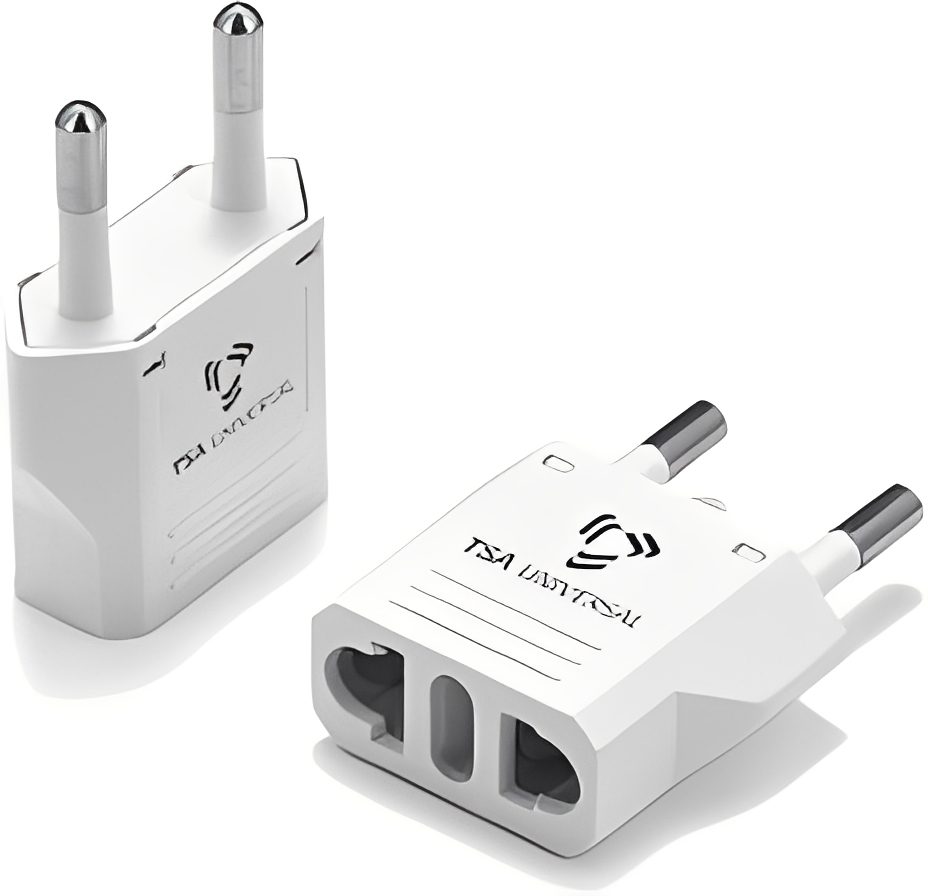
- 230volts, 50 Hz
- TypeC is the standard European adapter used in Type F is also used in Portugal. Be sure to purchase an adapter so you can charge your electrical devices.
- TSAUniversal Adapter is recommended.
- Electricityis available in all the B&B’s and hotels along our journey.
Cell Phone Coverage and Wi-Fi Access
Mobile phone and internet service will be intermittent throughout our daily hikes. There will be certain areas where there will be little or no coverage (e.g., the further points from the main towns and villages). Some carrier services may not be as great as others, so internet service may also depend on your mobile phone service provider. Your guide will be carrying a satellite phone in case of an emergency. When we are at our accommodations, we will almost always have Wi-Fi access.
Keeping Cell Phone Bills Low
To avoid large bills due to cell phone use while abroad, talk to your carrier to see what they recommend doing to keep your bills low. Your carrier may have a special package that allows unlimited texting and cheaper phone calls while you are away. If not, investigate the 2 options below, and/or others that you know of that would be useful in Portugal. Be sure to set up the ones you choose and practice with friends and family before you go.
Other Options
WhatsApp allows you to text and call friends and family from anywhere in the world when connected to Wi-Fi. Your friends and family also need to have WhatsApp for this to work. It is very easy to download this app and get connected.
Zoom/Teams: Useful for making phone calls and video chats. There may be a small fee per minute or low monthly subscription rates.
Airplane mode: Some people choose to put their phone on airplane mode for the whole trip and just use it for the camera function and then connect to the internet via wireless service when available.
To get the most out of your trekking experience: Use your cell phone and other technology as little as possible. Many people report that “unplugging” is one of the highlights of their trek.
Airport Tips
Baggage
*All your bags should have tags with your name, address, phone number, and email address.
If checking your bags: Check your bags to your destination. This way, you won’t have any bags to collect in a city where you may have a layover and can quickly get through customs. Have everything you need for trekking in your carry on in case of baggage delays.
If carrying your bags on the plane: If you are a light packer, you can choose to carry your bags with you on the plane. This would avoid the possibility of lost bags. Be sure that your “light” baggage fits the size rules for your airplane. However, you may have to check your trekking poles (post offices have long tubes that you can pack your poles in so they can be checked). And remember that you cannot carry on any form of hiking pocketknife.
Airport security is extremely tight worldwide. Know airport security requirements before you pack your check-in or carry-on bags to determine what can or cannot be included in them.
Carry all your cash, credit and debit cards, passport, medications, epi-pen etc. with you in your carry- on bag. Don't put them in your checked baggage. You also might consider wearing a money belt underneath your clothing when traveling in busy places (airport, underground metros, buses, cities etc.).
TSA Locks
Transformational Trekking highly recommends locking your bags as theft can happen in any airport. You must use TSA approved locks (available at many retailers in the US). The Transportation Security Administration (TSA) has the responsibility for screening every piece of checked luggage at commercial airports throughout the US. Baggage handling agents may require access to the contents of your luggage and will break a non-TSA approved lock to access the contents of your bag.
Customs Upon Arrival to Portugal
All visitors are required to go through Customs and Immigration and show their documents (passport) upon arrival. Prior to showing your documents, you may be directed to a kiosk to type in your information, answer customs/immigration questions, and have your photo and finger print taken for the new EES system. It is important to follow the instructions that your airline gives you. Meat, fish, and dairy products are not allowed from the US into Portugal. Customs & Immigration as well as baggage collection, generally take about 60 minutes.
Directions & Transportation Once in Portugal
Getting to Your Hotel from Lisbon International Airport
The easiest way is by reserving an Uber ride or taking a taxi (about €25-30 euros depending on where you are staying). There is a taxi line just outside from where you will exit the airport. This line moves quickly. You can also take the airport metro line that takes you to Lisbon city center (‘Aeroporto Saldanha’ line). Riding the metro is cheaper, but it won’t drop you and your luggage off at the doorstep of your hotel.
Heading to Lisbon International Airport After the Group Trek
The easiest way is by reserving an Uber ride or calling a taxi (about €20-25). They can pick you up at our hotel and take you to the airport. You can also walk to the closest metro and take the ‘Aeroporto Saldanha’ line.
Day 1 Group Meeting Location
We will meet in the Baixa neighborhood of Lisbon just in front of Figueira by the Beautique Hotels at 10:15AM. More information will be given to you closer to the start of the trip. The address of the Figueira by the Beautique Hotels is: Praca da Figueira, 16 1100-241 – Lisboa.
Public Transport in Lisbon
- LisbonMetro Services: The link below provides useful information on how to use Lisbon’s metro. https://lisbonlisboaportugal.com/lisbon-transport/Lisbon-metro-guide.html
- LisbonBus Services: The link below provides useful information on how to use Lisbon’s https://www.lisbonportugaltourism.com/transportation/buses.html
- LisbonTram Services: The link below provides useful information about Lisbon’s Tram Services https://www.lisbonportugaltourism.com/transportation/trams.html
- LisbonFunicular Services: The link below provides useful information about Lisbon’s Funicular Services https://www.lisbonportugaltourism.com/transportation/funiculars.html
Portugal Contacts
If family and friends cannot get hold of you during the trek, one of the following would be the next best person to contact:
Bruno Nascimento (partner in Portugal)
Cell Phone: +351 914 217 201
Health in Country
Medical Problems
The most common medical problems during a trek in Portugal include:
- Constipationfrom changed diet
- Blisters
- Beesting
- Injuryresulting from falls
We will do our best to minimize any exposure to possible medical problems. However, being a cautious traveler is essential.
Blisters and preventing them:
- Trainfor the trek!
- Breakin your shoes/boots on training walks and hikes before the big
- Testa few different pairs of socks to find out which work the best for Many people like Smart Wool Socks as they are comfortable, breathable (helping to keep moisture away, therefore less blisters) and you can wear them multiple days without them stinking too bad. Liner socks are also popular to help decrease chances of blisters. Some people, who tend to suffer from blisters on their toes, like to wear the 5 toe socks to help prevent toe blisters.
- Whenyou feel a hot spot coming on, stop immediately and put a Band-Aid, or second skin over the area to prevent it from turning into a blister.
- Ifyou know you blister often, try putting Vaseline on your feet, then put your socks
- Tapeareas where you are known to This will help prevent your usual blisters.
- Ifyou do get a blister, try not to pop it unless it is painful, and/or you can’t walk on the blistered area. Do not use the needle thread method to drain the blister. This can cause the area to get infected. If you need to pop the blister, use a sanitized needle. Next, drain and clean the area and have sterile first aid dressings/bandages ready to place over the open wound.
Hiking is generally safe, but there are some inherent risks when walking on trails. Unfortunately, accidents can occur. Here are a few ways to prevent them from happening:
- Whilewalking along the clifftops, never get too close to the Keep your distance as cliff edges can be very unstable and break away, causing injury and or death.
- Whilehiking along a trail, attend to the If there’s something interesting to look at or photograph, stop first, look, take the photo, and then continue.
- Givethe person hiking in front of you adequate space as you hike along the More space (at least 3-5 seconds of space) should be given when hiking up steep hills and down steep hills.
- Beaware of who is trekking in front of you and behind Never leave the group without a conversation with the group leader first.
Use caution when crossing the street, as drivers may not stop for you like they do in the US.
Animals to be aware of along the trail:
While most dogs, and farm animals and wild animals that you may come across are harmless and mostly curious about you, some may feel threatened and scared. Respect their living space and admire them from a distance.
- Wild Boar:It would be rare for us to encounter a wild boar while on our trek as they are mostly active at Wild boar attacks on humans are extremely rare and uncommon as they shy away from humans. If we do encounter a wild boar: stay calm and move slowly away from the animal. Do not approach, corner, feed or photograph the animal. A flash from a camera could startle and provoke the boar. Stay well away from young boar and their mothers. Wild boars generally will not attack unless they feel threatened for themselves or their young.
- Cowsand Bulls: If you are in an area where there are young cows, be sure to give them a lot of space, as protective mothers and the bull are not far Do not go near a bull, especially
when their young are around. Do not stare at a bull. Bulls may attack to protect their young ones. When we hike alongside farmland, we will do our best to keep our distance from both the cows and bulls. (FYI: most cows on this trek are behind fences – most likely we will not encounter any on the trail.)
- Ifa cow slowly moves towards you: Do not For the most part, they just want to sniff you and are genuinely curious about you. Continue walking quietly without large movements at a steady pace towards an exit point. If they come within touching distance give them a gentle nudge to alert them of your presence.
- Ifa cow or bull charges you: Make yourself as big and loud as Throw your arms with your poles in the air and shout. If this doesn’t work run downhill if possible and only if your exit is close (20 meters/65 feet or less) as they can easily outrun humans. If not possible, and the cow gets within touching distance, hit, or punch them in the nose as a last resort. You can use your trekking polls to give them a good whack on the nose.
- Goatsand sheep: For the most part these animals will run away from However, some rare outgoing goats and sheep may come up close to sniff you.
- Dogs: Be mindful of dogs that are not on a leash or behind a fence. Some dogs look nice enough but will protect their territory if they feel It is best to keep your distance from all unknown dogs.
Basically, follow this guideline: Wild animals, farm animals, dogs and horses can behave unpredictably if you get too close, especially in the spring when they’re with their young. So, give them plenty of space!
Bugs to be aware of along the trails:
- Mosquitoes: Mosquito activity usually occurs between May and October.However, with climate change this may also Lemon Eucalyptus oil can help keep mosquitos away in a natural way or you can try typical insect repellents found at outdoor stores like REI to try to keep the mosquitos from biting you. If you get bit, you can take antihistamines to stop the worst of the reaction to any bites or rub Hydrocortisone Cream on the bites to relieve the itching or another cream that you know works for you.
- Bees/Hornets/Wasps: Like the US, Portugal has many varieties of bees, hornets, and wasps. The Asian hornet, not native to Portugal is being seen more and more.If you know you have unhealthy reactions to bee stings, be sure to bring your EpiPens just in case of an encounter. Honeybees and black violet bees (carpenter bees) will be feeding and pollinating on the plants close to the trail. Both bees are very docile but can sting if they feel threatened. The black violet bee may seem more dangerous due to its size, but it is not!
- Ticks: Portugal has over 20 different types of ticks.They can be found anywhere there is wildlife, near the edge of forests, tall grassy areas, and shrub The real problem with ticks is that they can carry diseases such as Lyme Disease (Borreliosis), a potentially very serious bacterial disease, and Mediterranean spotted fever (MSF), as well as Tick born encephalitis (although very rare in Portugal). To prevent tick bites, it is highly recommended to wear long
hiking pants and long sleeve shirts. You may also consider wearing gators to close off any exposed skin around your ankles and shins. Stay on the footpaths and avoid walking through long grass and areas of thick foliage. After hiking, check yourself for ticks - not forgetting to check your hairline, navel, armpits, groin, behind the ears and knees and between your toes. If you find a tick, be sure you know how to properly remove them. Your leader will have a proper tick removal kit. (See the Immunizations/Vaccines & Contagious Illness Requirements section on page 5 for more information on TBE.)
What to Expect on the Trek
A Typical Day:
| 6:00-7:00am | Wake up. |
| 7:00-8:30am | Dress and repack your bags. Leave them where advised the night before, then head to breakfast. |
| 9:00-9:30am | Begin the days trek. All you need to carry is your daypack with the day’s essentials. |
| 12:00 PM | Stop for lunch. We will have at least one other stop prior to lunch to rest and have a snack. |
| 2:00pm-6:00pm | The trek day typically ends in the mid to later afternoon (2PM-4PM). The 11- mile day may end closer to 5PM. Upon arrival on shorter days, there is time to explore your surroundings, journal & reflect on your memorable day, text home, do laundry or nap before dinner. |
| 7:00 – 9:00pm | Eat dinner with the group either at our guesthouse or a restaurant in town. |
| 9:00 -10:00pm | Time to go to bed! A good night’s sleep is very important! |
Lodging
You will be staying in charming guest houses, boutique type hotels, as well as a couple of hotels that are more typical of bigger city hotels.
Food
Breakfast will be provided by the place of stay. All but 2 lunches are included in the cost of the trip. We will eat either in a restaurant, when not trekking, or picnic style when on the trek. We will eat dinner out at local restaurants or in our hotel. *It is recommended to bring one trail bar per day from home to eat on the trail. For a few more specifics about the meals see the trip Itinerary.
Water
Transformational Trekking recommends one refillable water bottle (20-32 ounces) and one 70-ounce water bladder. You will be able to fill them up at our place of stay and sometimes in restaurants along the way. Know that there are not always places to fill up each day, so for the most part you will need to take enough water to last you until lunch, where our guides will have more water for us. Some of the water in our accommodations is not the best drinking water, in these cases, our drivers will have healthy water for us to use.
Luggage
The gear you are not using during the day’s hike will be transferred to the next place of stay. The weight allowed for the transferred bag is 20kg/44 pounds, however, make it your goal to pack less! Upon arriving at the B&B or guesthouse, you may need to carry your luggage up flights of stairs. Make sure your luggage is not heavier than you can handle. During the trek you will carry a daypack containing items such as rain gear, and other needed layers, camera, water, first aid kit, snacks, and any other essential items.
Charging electronics
You will be able to charge your camera batteries and phones at lodgings.
Laundry
Washers and dryers are generally not available while on the trek. We can hand wash clothes and hang them to dry in designated areas. Note that cotton and heavier fabrics will not dry easily. It is recommended to bring quick drying fabrics.
Time Difference
Portugal is 8 hours ahead of Pacific Standard Time
Tipping
A suggested tipping scale while in Portugal (pre and post trip) is shown below:
- Eatingout: no more than 10% of the bill
- Coffeeshop: not expected, but some people round up and give the change
Fun Facts About Portugal
- Top5 languages spoken in Portugal:
- Portuguese
- English
- French
- Spanish
- Mirandese
- Portugalis one of the world’s top surf It has 497 miles of coastline and is said to have 364 days of surfing per year.
- Portugalis famous for port wine – a dessert
- Afavorite Portuguese pastry is the Pastel (Pastéis) de nata, a custard
- Portugalis known for their Azulejos
- Portugalis the oldest country in
- Lisbonis home to the oldest still-operational bookstore in the world (Bertrand or Livraria Bertrand).
- Portugalis the largest cork producer in the world, having 70% of the world’s cork exports and boasts the world’s largest cork forests.
- Portugaland England have the longest diplomatic alliance in the world (the Anglo-Portuguese alliance signed in 1373).
- Tempurais
- Thehighest mountain in Portugal is Mount Pico at 7,713 feet above sea
- Noone in Portugal has been executed for a crime since 1846, and capital punishment was outlawed in 1867. The maximum number of years anyone can spend in jail is 25.
- Sixto eight million pilgrims’ journey to Fatima in Portugal each
- Therooster is the symbol of
- Lisbonis older than
- Portugal’snational song is known as It holds UNESCO's Intangible Heritage of Humanity award and is celebrated the world over as a major performing art. Fado is fate or destiny translated into music.
- Portugalis the 3rd highest consumer of fish on the
Weather
Average Temperatures for the month of April in degrees Fahrenheit and degrees Celsius:
| April: 68 | 53 | Lisbon | 20 | 11.7 |
| April: 66 | 52 | Porto Covo | 18.9 | 11.1 |
| April: 68 | 53.6 | Odeceixe | 20 | 12 |
| April: 66 | 53 | Sagres | 18.9 | 11.7 |
Map of the Daily Starting & Ending Points for our Trek
10-DAY TREK - 70.6 - 75.6 MILES
Day 2: Porto Covo to Forte Pessegueiro
(2 hours)
2.5 miles/4km
Day 3: Forte Pessegueiro to Vila Nova Milfontes
(6 hours)
8.3 miles/13.4km
Day 4: Vila Nova Milfontes to Almograve
(5.5 hours)
7.5 miles/12km
Day 5: Almogrove to Porto das Barcas
(7 hours)
11.5 miles/19km
Day 6: Brejao to Odeceixe
(5.5 hours)
8.1 miles/13km
Day 7: Rest Day or Circular Route in Odeceixe
(5 hours)
0 - 5 miles/0-13km
Day 8: Aljezur to Arrifana
(5.5 hours)
7.5 miles/12km
Day 9: Carrapateira to Amado Beach
(5 hours)
6.5 miles/16km
Day 10: Circular Route from Vila do Bispo
(5 hours)
6.2 miles/10km
Day 11: Vila Do Bispo to Cape St. Vincent
(6 hours)
8.7 miles/14km
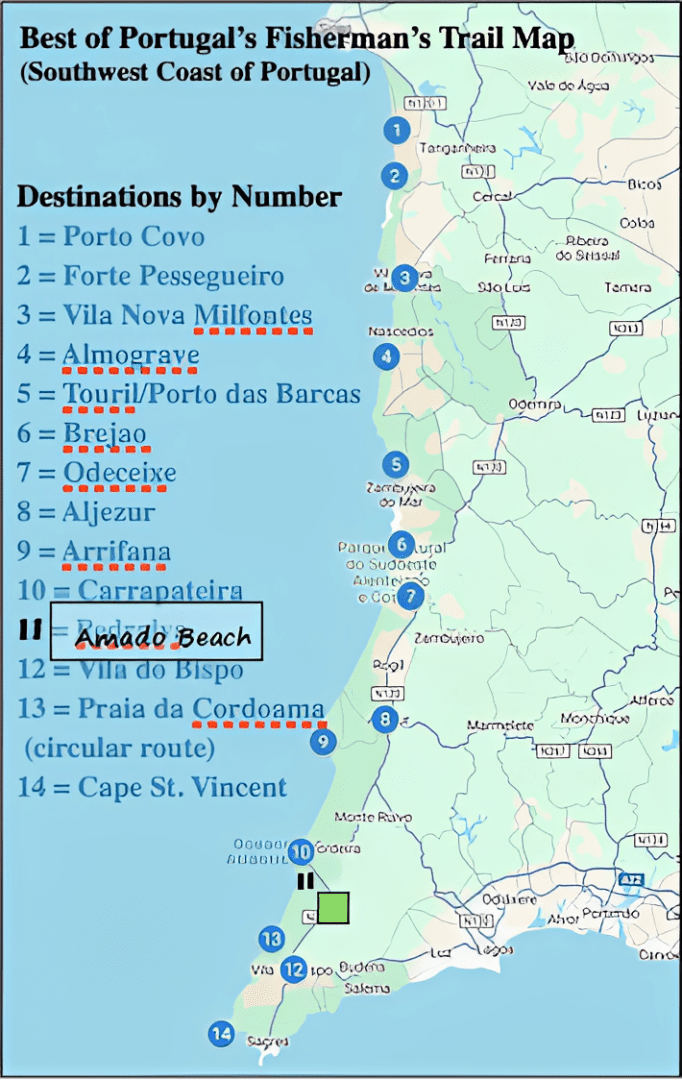
*The hour estimates assume an approximate 3.0 mph or faster pace on flatter dirt trails and 1.75 - 3.0 mph pace on hillier and more rugged sandy sections, and includes lunch and breaks on the trail. It is quite possible that we will finish before the estimated timeframe.
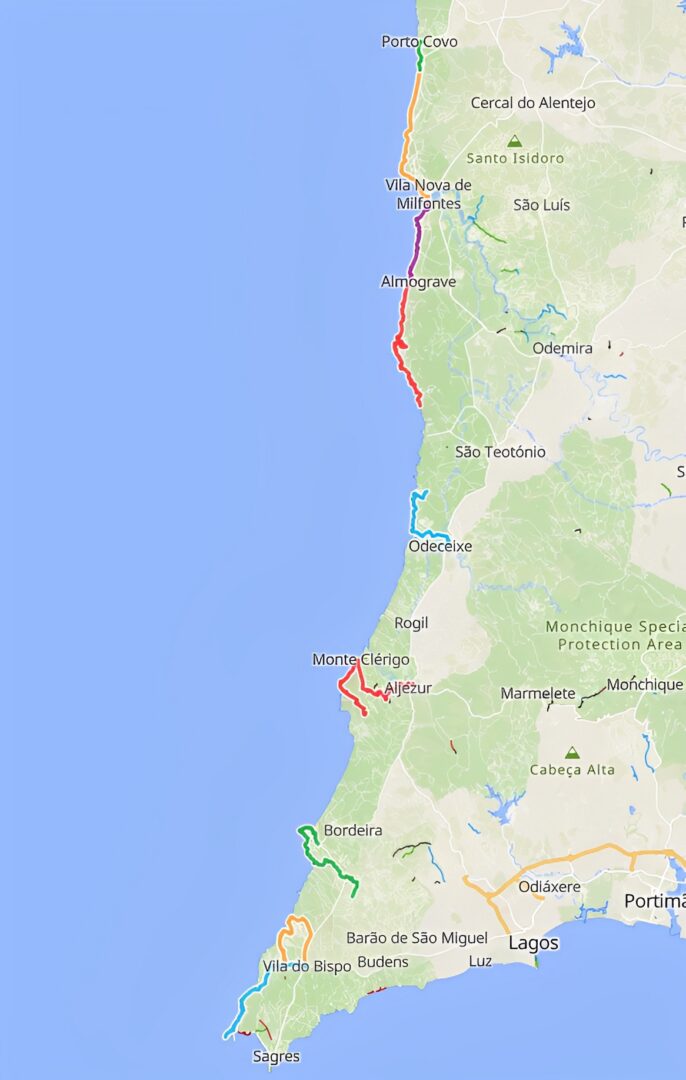
Daily Routes Map
Each color represents a day’s hike, starting in Porto Covo and heading south along the coastline to Cape St. Vincent (Cabo de Sao Vicente).
*Transformational Trekking LLC is registered as a seller-of-travel with the Washington State Department of Licensing. Transformational Trekking’s registration number is: 603135665.
This content is restricted to site members. If you are an existing user, please log in. New users may register below.